

Takeanap to Solve the Dilemma After Generative AI - How its AI Agent ‘D:bo’ Assists in Design Decision-Making

Saemi Jung, CEO of Takeanap
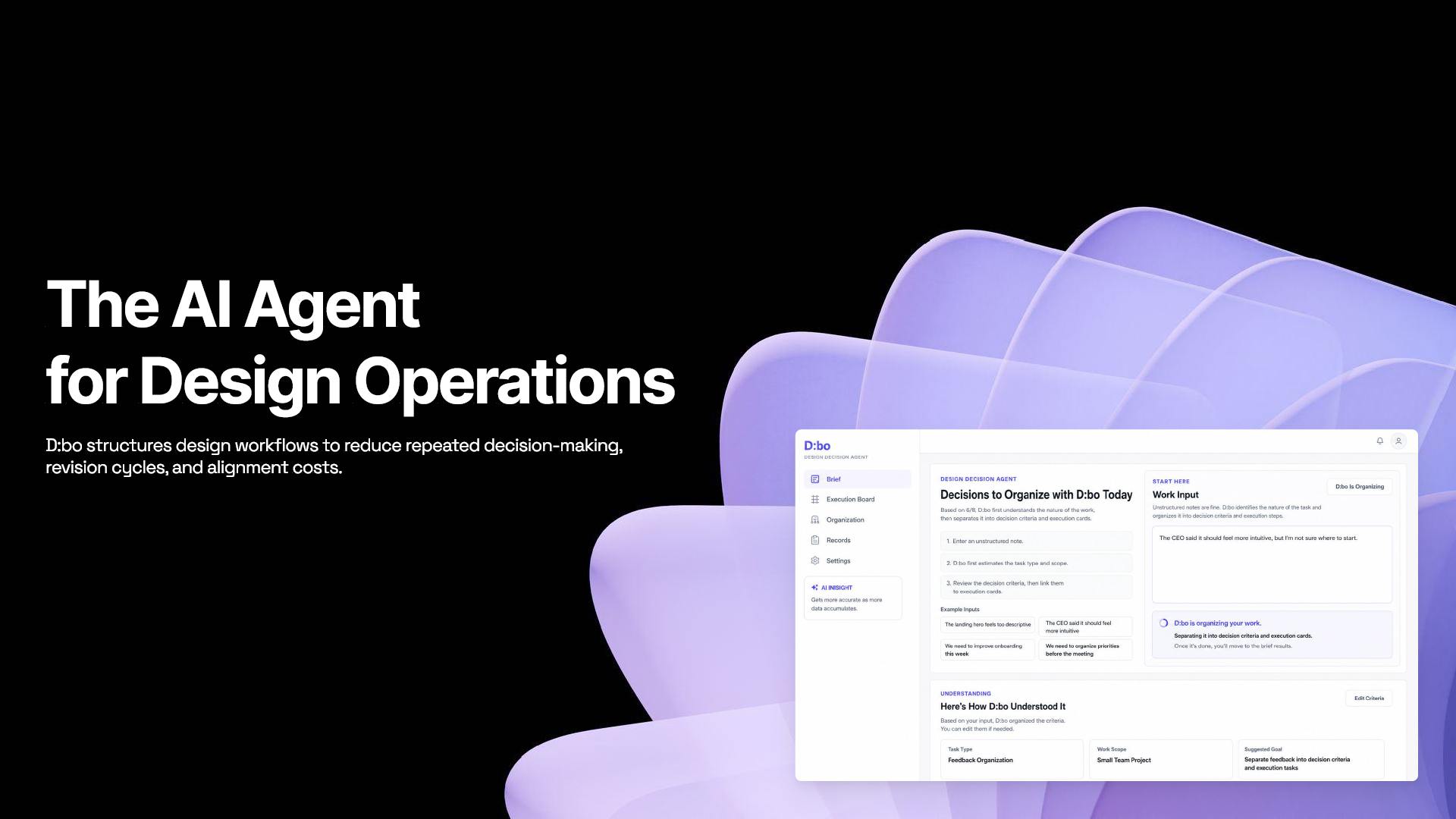
The Al Agent for Design Operations: D:bo structures design workflows to reduce repeated decision-making, revision cycles, and alignment costs. | Image provided by Takeanap

Service Overview of D:bo, showing a flow chart of Plan (Context & Scenario), Execute (Decision in Motion), and Reflect (Memory) | Image provided by Takeanap
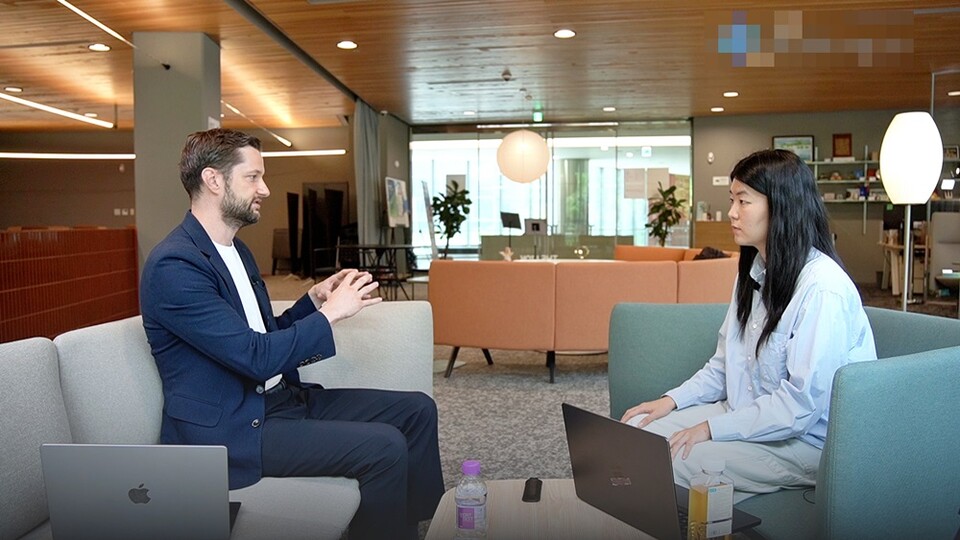
Reporter Thomas Frederiksen (left) conducting the interview and Saemi Jung, CEO of Takeanap (right) responding to questions
“Our Platform Overcomes Workflow Inefficiencies by Structuring Design Requests, Feedback, and Shared Updates into Actionable Work Data Layers.”
PANGYO, GYEONGGI-DO, SOUTH KOREA, July 28, 2026 /EINPresswire.com/ -- Led by CEO Saemi Jung, Takeanap designed its corporate name to suggest that humans can delegate tasks to Artificial Intelligence, then take a nap or use that time elsewhere. The platform was formulated based on the CEO’s firsthand professional experience across development, design, and marketing. While conventional generative AI has enabled the rapid generation of design assets, Takeanap addresses the problem that a substantial number of human person-hours are still spent during subsequent alignment processes—such as selecting and modifying outputs or exchanging feedback.According to Takeanap’s analysis, the cost of judgment—where decision-making is delayed, and discussions recur—is estimated at approximately 700 million KRW for a 300-employee design organization. A major driver of this cost is the fragmentation of professional feedback and decisions across collaboration tools such as Slack, Notion, and Figma, leading to the loss of historical records. To resolve this issue, D:bo functions as a design workflow AI agent, organizing design requests, progress status, feedback, and shared updates into actionable work cards and reports.
D:bo converts workflows into data through a continuous cycle of planning, execution, and reflection. When a user submits a work request, the AI structures it as a ‘Decision Card’ and visualizes operational progress by integrating with tools such as Figma and Slack. The data regarding reasons for modification or feedback generated during this framework accumulates in the design decision layer, making it reusable as a benchmark for judgment in future projects. In the long run, D:bo plans to expand into a six-agent architecture responsible for report generation, sharing automation, feedback structuring, visual context expansion, and decision-making support.
Importantly, D:bo draws a clear distinction from traditional AI tools that merely generate outputs. While Figma agents or Motif AI specialize in editing and productivity, and Uizard or Google Stitch focus on early ideation, D:bo stands as an integrated workflow management solution optimized for professional designers and team collaboration following asset generation. Furthermore, unlike methods like Confluence, where users must manually compose documents, it harvests and structures data that naturally occurs within the workflow. For this initiative, Takeanap is targeting teams comprising design leaders, PMs, and product designers at early Series A startups with 5 to 20 employees as its primary demographic.
Pangyo Techno Valley met with Takeanap CEO Saemi Jung at The LINK in Pangyo Startup Campus to discuss their design operations platform, hidden enterprise judgment costs, and upcoming global validation roadmaps. Reporter Thomas Frederiksen conducted the interview.
Q1. Thomas Frederiksen, Reporter: Can you tell me a little bit about what kind of company D:bo is? What is the story behind the company?
A. Saemi Jung, CEO of Takeanap: We started the company because we are entering an era in which we can delegate work to AI services, freeing up much of our time for other activities. Our original team goal was literally to “assign the work to AI and take a nap.” We used that concept as our initial project name, which eventually stuck and became our official company name, though our core B2B service itself is called D:bo. We built an AI-powered design operations agent that structures the overall workflow of design teams to support their end-to-end tasks. My own career began as a designer, and the product was developed based directly on my personal experiences across development, design, and marketing to address the exact operational pain points I faced in the field.
Q2. Thomas Frederiksen: Why did you choose to focus on the design process and workflow tracking rather than just creating another tool that focuses purely on final outputs?
A. Saemi Jung: In design, the process is actually just as important as the final output. Understanding the intent behind certain revisions and tracking the route taken to achieve the final result is vital. Ever since generative AI burst onto the market, pulling out final design outputs has become incredibly fast. People might naturally assume that because generating images is faster, the design process as a whole has sped up. However, when you look more closely, only the asset’s generation is faster. The actual decision-making and judgment phase still relies entirely on humans, and teams end up spending a massive amount of time evaluating and aligning on those iterations. Ultimately, across the entire project timeline, companies are still spending the same amount of time. We identified this decision-making bottleneck as a major hidden cost and risk for companies, which inspired us to build a product that mitigates it.
Q3. Thomas Frederiksen: Can you elaborate on the financial impact of these design operations bottlenecks and how D:bo works to resolve them?
A. Saemi Jung: When that decision-making process gets rolled back constantly, and discussions repeat endlessly, it creates what we call a “judgment cost.” When we projected this across a design organization of about 300 people, we estimated that these recurring bottlenecks cost the company roughly 700 million KRW annually due to lost efficiency. Our product is designed not to create the final artwork, but to systematically capture the evaluation and decision-making process as data. More specifically, when revisions, task requests, and feedback occur during the design process, our AI structures that unstructured chatter and converts it into actionable execution cards. Once a project concludes, these execution cards are compiled automatically into comprehensive project reports and retrospectives, drastically reducing the overall time and judgment costs incurred by design teams.
Q4. Thomas Frederiksen: Instead of having decisions scattered across different messaging threads, D:bo keeps it organized. Exactly what part does the AI play in this ecosystem?
A. Saemi Jung: Our core keyword is establishing and tracking the team’s decision-making baseline. Designers typically use an array of specialized tools. At the same time, PMs and leaders use separate documentation apps, collaboration suites, and messaging platforms, so final decision data constantly fragments across Slack, Notion, and Figma. From a corporate standpoint, this accumulation of fragmented data builds operational risk. Designers spend most of their time working in tools like Figma or Adobe suites, where the vast majority of the design team’s operational workflow and feedback loops occur via canvas comments. Our AI analyzes these contextual comments to understand the team’s current decision-making trajectory. It continuously accumulates this data to map out team-specific preferences—for instance, noting that when a specific type of task arises, Team A heavily prioritizes certain aesthetic or functional metrics during their review. The AI continuously learns the team’s operational patterns to provide hyper-fit alignment suggestions, systematically reducing the compounding judgment costs over time.
Q5. Thomas Frederiksen: Who are your primary target customers, and how are you validating this B2B service with them?
A. Saemi Jung: We place our primary priority on design teams where design leaders, PMs, and managers collaborate closely in a shared environment. Our ideal targets are fast-moving, lean startups and collaborative corporate teams that require rapid alignment, with a focus on early Series A startups featuring 5 to 20 employees. Before officially launching our B2B D:bo service, we operated a B2C portfolio feedback service in which our AI analyzed design portfolios to help designers elevate their work, successfully aggregating a high-quality dataset of over 600 real-world design projects. Moving forward, we plan to initiate full-scale B2B Proof of Concept (PoC) validations through our ‘Design Decision Bootcamp’ tailored for corporate clients. Operating for a total of 60 days, this program consists of a two-week diagnosis of each team’s workflow, followed by a six-week live test deploying D:bo into actual operations to minimize unnecessary design-team modification iterations while robustly validating team-level paid conversion potential.
Q6. Thomas Frederiksen: Looking ahead, what is your roadmap for scaling this product internationally, and how has your experience been within the Pangyo Techno Valley ecosystem?
A. Saemi Jung: Our ultimate focus is squarely on the global market. While the design market in South Korea is substantial, the scale of demand, operational maturity, and integration of design operations are significantly larger in international markets. We are targeting the North American and English-speaking markets first because our main customer profile consists of fast-moving, lean startups, and the highest concentration of such organizations with well-developed remote collaboration cultures is in the United States, followed closely by Europe. Our relationship with Pangyo initially began last year through a local startup incubation and acceleration program. That initial traction led to our current on-campus office residency, where we are actively building out our product. Pangyo provides the ultimate ecosystem where an IT company can build, run extensive tests, and interface directly with a dense customer base of tech-forward teams. Our strategy is to thoroughly validate our product fit here with local startups utilizing global workflows, and once that validation phase is complete, immediately launch onto the global stage.
Kim Seung Yeon
Gyeonggi Business & Science Accelerator
+82 31-776-4834
email us here
Visit us on social media:
LinkedIn
Instagram
Facebook
YouTube
Other
Legal Disclaimer:
EIN Presswire provides this news content "as is" without warranty of any kind. We do not accept any responsibility or liability for the accuracy, content, images, videos, licenses, completeness, legality, or reliability of the information contained in this article. If you have any complaints or copyright issues related to this article, kindly contact the author above.
